
“This is the world of Arthur and Urien: of the Picts and Britons and Saxon migration; of magic and war, myth and miracle.”
As Tolkien knew, Britain in the ‘Dark Ages’ was an untidy mosaic of kingdoms. Some – like Wessex, Mercia, Northumbria and Gwynedd – have come to dominate understandings of the centuries that followed the collapse of Roman rule. Others, however, have been left to languish in a half-light¸ forgotten kingdoms who followed unique trajectories before they flamed out or faded away. But they too have stories to be told: of saints and gods and miracles, of giants and battles and the ruin of cities. This is a book about those lands and peoples who fell by the wayside: the lost realms of early medieval Britain.
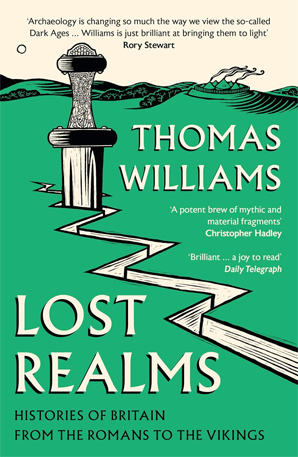
In Lost Realms, Thomas Williams, bestselling author of Viking Britain, focuses on nine kingdoms representing every corner of the island of Britain. From the Scottish Highlands to the Cornish coastline, from the Welsh borders to the Thames Estuary, this book uncovers the forgotten life and untimely demise of realms that hover in the twilight between history and fable. ELMET. HWICCE. LINDSEY. DUMNONIA. ESSEX. RHEGED. POWYS. SUSSEX. FORTRIU. The grave-fields and barrow-mounds of these shadowed lands give up the bodies of farmers, warlords and queens, a scattering of their names preserved on weathered stone and brittle parchment. Their halls remain as ghost-marks in the earth, their hill-forts clinging to rocky outcrops. This is the world of Arthur and Urien, of Picts and Britons and Saxon migrations, of magic and war, myth and miracle.
Certain questions echo throughout the biographies of these lost realms. How are kingdoms formed and why do they fail? How do communities adapt to change and how do they insulate themselves from it? How do they construct the past? How do they deal with loss or forge a sense of belonging? The people of early medieval Britain dwelt deeply on lost pasts, siting their churches within the tumbled walls of Roman cities, burying their own in the grass-grown tombs of people millennia dead. They spun tales of tarnished treasures and broken swords, of the world they knew and the pasts they imagined. And they fought and loved and toiled with as much vigour and joy as in any other age, and suffered grief and disappointment just as cutting as our own. Lost Realms restores something of those voices: a chorus of whispers in the dark.
PRAISE FOR LOST REALMS
Nominated for Current Archaeology Book of the Year 2023
‘This brilliant history of Dark Age Britain mixes serious scholarship with nods to pop culture, from Tolkien to The Wicker Man . . . Williams has all the necessary expertise in spades . . . That is what good books do – they leave you wanting more, and Lost Realms is a joy to read’
Telegraph, five-star review
‘Thrilling . . . intriguing . . . Williams makes a compelling guide as he steers us through the darkness . . . And at times, he’s even downright funny’
Spectator
‘By blending evidence from the scanty texts we have with up-to-date archaeology, plus piquant, even romantic evocations of sites and landscapes, Lost Realms paints a broad picture that makes credible sense . . . Sceptical, scrupulous, written with wit and flair’
Financial Times
‘Thomas Williams is an exceptionally vivid and exciting writer, and his wonderfully evocative recreations are just what the generally impoverished and bewildering evidence for early medieval Britain requires. He is also however a meticulous, honest and fair-minded scholar, and his careful analysis of that evidence, material and textual, always establishes its limitations as well as its potential. His consideration of the losers of Anglo-Saxon state building provides a genuinely original and illuminating perspective on how England came to be’
Ronald Hutton, author of The Witch
‘A beautiful, beautiful book . . . archaeology is changing so much about the way we view the so-called Dark Ages … [Williams] is just brilliant at bringing them to light’
Rory Stewart, The Rest is Politics podcast
‘Thomas Williams has blended a potent brew of mythic and material fragments to raise forgotten kings & queens (and their stories) from the grave. An historian not afraid of the dark and with eyes adapted to it – what he sees is assessed sagely and described beautifully’
Christopher Hadley, author of The Road
‘In recovering what he can of the near-vanished histories of Britain’s lost realms, Williams has done an admirable job, evoking the spirit of an age that was both chaotic and creative, from the ferment of which England and ultimately Britain emerged. It is a gift indeed to be reminded that Dumnonia, Lindsey, Fortriu, Hwicce, Elmet and Rheged – faint ghosts of places though they may now seem – made their own contributions to what we are today’
Literary Review
‘Thomas Williams’s Lost Realms offers an imaginative alternative to [the] standard historical narrative. Under Williams’s pen, the traditional story of seven large kingdoms – the so-called heptarchy – makes way for one of nine “minor” kingdoms: Elmet, Hwicce, Lindsey, Dumnonia, Essex, Rheged, Powys, Sussex and the Pictish kingdom of Fortriu . . . Rich and captivating’
Times Literary Supplement
‘Williams has a fine command of the literary, administrative, religious and archaeological sources of early medieval Britain. He is a diligent scholar and a likeable writer’
The Times
‘A rich and fascinating exploration of our land’s past, made all the more intoxicating by Williams’s writing. He is a bard’
Giles Kristian, author of The Arthurian Tales series
‘A refreshing new study on a topic that definitely needed this kind of attention from an academic historian. No axe to grind, bang up to date and accessible to a wide spectrum of readers’
Tim Clarkson, author of The Picts: A History
‘As well as piecing together fragments of material evidence, Williams thoroughly interrogates early medieval written sources both ‘historical’ and literary, teasing out flickers of insight as well as addressing their limits … Williams’ resonant prose conjures vivid images of its own … has the ring of an Old English elegy’
Current Archaeology
‘The book is beautifully written, pushing at the very limits of our ability to understand the early medieval world’
British Archaeology

 THOMAS J. T. WILLIAMS