
A few weeks ago, I had an article titled The Battle of Ashdown: Victory, battlefield, and the language of war published in Medieval Warfare magazine. The theme of the issue is Alfred the Great and the Great Heathen Army and thus coincides neatly with my own area of academic interest. The publication is not scholarly, but contains a good deal of interesting material and is nicely produced with some superb commissioned illustrations.
Continue reading “The Battle of Ashdown in Medieval Warfare”Autumn
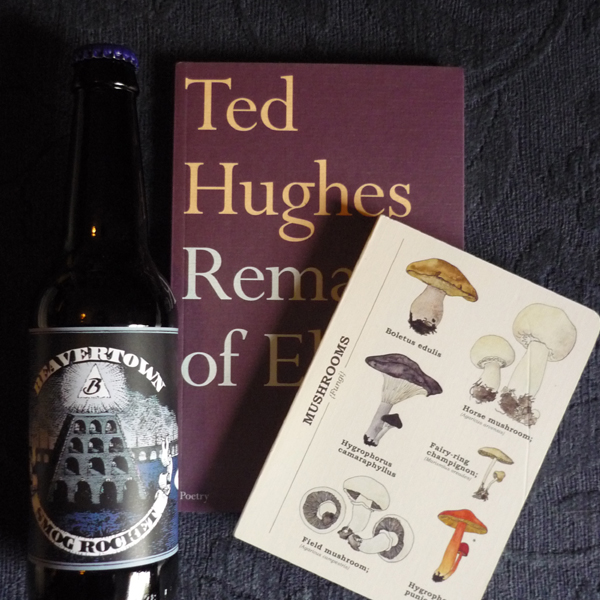
On one of the first days of October I went walking with my wife. I found my first conker of the year, with the beautiful patina and texture of newborn wood. It’s already wrinkled, like a hard shiny prune. After the walk I went shopping and bought a small collection of objects. I hadn’t intended them to be a collection, but when I looked at them together I was struck how my emotional response to the season was reflected in the things I had chosen. The warm, rich, smoked flavours of Beavertown’s Smog Rocket is full of the scent of bonfires and leaf litter.
Book Reviews: Alfred’s Wars and Viking Warfare
Two reviews (by me) of titles published in the last couple of years on the subject of early medieval warfare can now be read online.
The first is a review of Ryan Lavelle’s Verbruggen-prize-winning Alfred’s Wars: Sources and Interpretations of Anglo-Saxon Warfare in the Viking Age (Boydell 2010) which, apart from its slightly misleading title (it happily ranges far more widely than the mention of Alfred implies), thoroughly deserves all the praise it has received. It is also, as of last year, out now in paperback for a very reasonable price.
The second is my review of I. P. Stephenson’s Viking Warfare. This has the distinction of being my most read article on academia.edu, although I suspect that this is testament to the popularity of ‘Viking Warfare’ as a search term, rather than any great desire on the public at large to discover my opinions of Mr Stephenson’s book. In hindsight, I would soften my criticism of Stephenson’s approach, and in particular his comments regarding the shift in military fashions over the tenth and into the eleventh centuries. However, I still take issue with some of the assumptions made by the author given the paucity of the material evidence. Nevertheless, this is still one of the better efforts addressing this subject currently in print.
Ringmere
Yesterday I visited the site that has long been associated with the Battle of Ringmere (as named by John of Worcester and called Hringmaraheiðr in various Norse saga accounts which include some fascinating contemporary skaldic verse relating to the battle). The connection of the battle to a remarkable geological feature – Ringmere – on Wretham Heath is a long-standing one, which has only recently been seriously challenged in a well reasoned article by Keith Briggs that appeared in ‘Notes and Queries’ [read it here]. Nevertheless, the site at Wretham remains a compelling one, not least due to the preservation of an open and atmospheric landscape thanks to the designation of Wretham Heath as a nature reserve (run by the Norfolk Naturalists Trust).

Ethandune, that savage and sacred spot

In the last few weeks I have been considering the location of the iconic battle of Ethandune for a chapter submitted for inclusion in an edited volume of essays on the ‘Danes in Wessex’ (Lavelle and Roffey (eds.) forthcoming). Whilst poking about in the literature, I came across the following lines written by G.K.Chesterton and published in 1911 in his collection of essays ‘Alarms and Discursions’ (Dodd, Mead and Company). The location that Chesterton describes – the environs of Edington (Wilts.) and the prehistoric enclosure at Bratton Camp – has since been established fairly securely as the site of the battle (although, as Ryan Lavelle has shown, this was by no means an uncontentious view when Chesterton was writing; Lavelle 2010, 302, 308-14). His lines are a powerful evocation of the way in which weather, landscape and the memory of violence can combine to exert a powerful pull on the imagination – a power which must have been no less in Alfred’s day than it was in Chesterton’s or, indeed, our own:
Continue reading “Ethandune, that savage and sacred spot” THOMAS J. T. WILLIAMS