Silver, swords and wool

© Trustees of the British Museum.
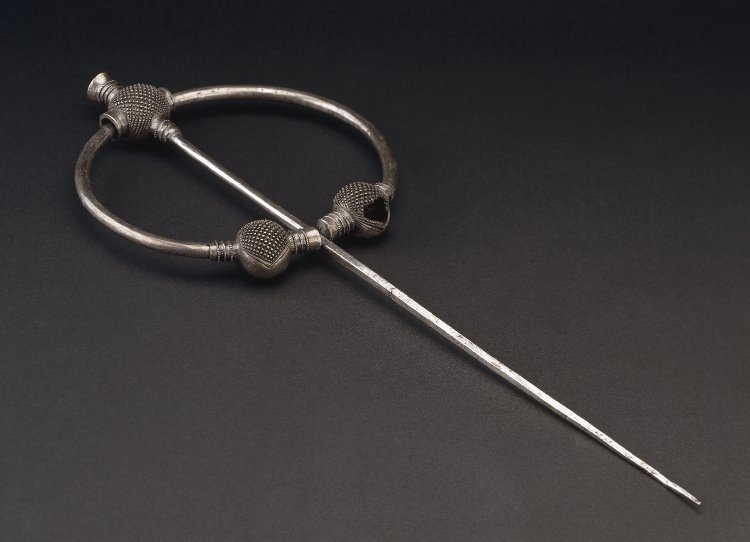
10th century penannular ‘thistle’ brooch from Fluskew Pike near Penrith, Cumbria (© Trustees of the British Museum)

Silver and gold, weapons and slaves, shields and long-ships: these, we might imagine, are the proper accoutrements of the sea-borne rover… knitwear not so much.

But unless we are foolish enough to believe in the sword & sorcery stereotype of the barbarian-in-naught-but-furry-loin-cloth, a hard life on the north-sea margins demanded proper clothes. And, whilst furs were an important part of Viking dress (and an important trading commodity), it was woolen cloth that was essential to many aspects of Viking life: sartorial, social and nautical.

Continue reading “Silver, swords and wool”

The Marauding Beard

“beardlessness, the sagas suggest, was not a desirable attribute. In the Saga of Burnt Njal, the eponymous hero is mocked as a ‘beardless old man’ (Old-Beardless) and his children as ‘little dung-beards’ (Dung-beardlings).”

My editor once told me that I have a ‘marauding beard’. I’ve never been able to decide whether she meant that the beard itself was out of control, invading my face with wild abandon, or whether she simply thought it was a good beard to go marauding in. Either way, as an historian of the Viking Age I took it as a compliment…

Continue reading “The Marauding Beard”

BBC History Magazine: the battle of Hengest’s Hill

The September issue of BBC History Magazine is still on news-stands, featuring my article on forgotten battles of the Viking Age. I was delighted to make it onto the cover:

Here’s an extract from the pre-publication draft:

Continue reading “BBC History Magazine: the battle of Hengest’s Hill”

Vikings in Russia

Ivan Biliibin, 1846 – 1942

Scandinavians traditionally do rather well at the Winter Olympics – for perhaps obvious reasons – but their Viking ancestors would have been no stranger to some of the delights of Sochi. Skis were used and valued in the North. Earl Rognvald I of Orkney boasted that (among several other skills) he could ‘glide on skis’, and the god Ullr was also associated with skiing. In fact, he has been taken as a sort of unofficial patron of the winter ski community, whose members often wear medallions depicting the god – there would no doubt have been a good number of Ullr talismans among the skiers in Sochi.

Continue reading “Vikings in Russia”